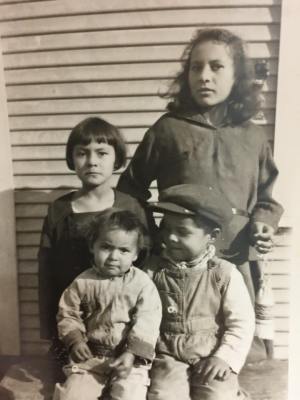
My mother, although half Comanche, always “passed” as white. At 18 she was selling tickets to the movies in the very small town where she lived. A young white civil engineer from Kansas came to the ticket window and they were married soon after.
My upbringing was white middle class. When I was in elementary school we visited my mother’s parents about once a year. I can still see my grandmother ‘s dark hands twisting the neck off a chicken and cooking delectable fried chicken with fry bread. I remember those experiences with fondness, but the feeling of belonging to the culture that my grandmother represented never developed for me.
I came to the point of wanting to own for myself some of my Indian heritage when I was old. I traveled to Oklahoma City and visited the U of O library. I found the pages of the small town newspaper that told little snippets of my mom’s family’s life. In the 8th grade she made the honor roll. Then I found the obituaries of her brothers. One died as a young teenager on Christmas Day when the car his brother was driving rolled over. That older brother died in a manner suited to a Greek tragedy. As you can see from his picture on my blog, he was an exceptionally attractive young man who excelled in high school sports. The fundamental question that haunted me after reading his obituary was how did this young man of half Indian blood with such promise in his eyes die as a drunk on a highway at midnight?
I felt compelled to try to answer that question. My novel which I envision in three parts will, I hope, help explain his death. The first two books are prequels: the first book covers the pre-reservation time, while the second book encompasses the allotment and the pasture money time. Chief’s story comes in the last book.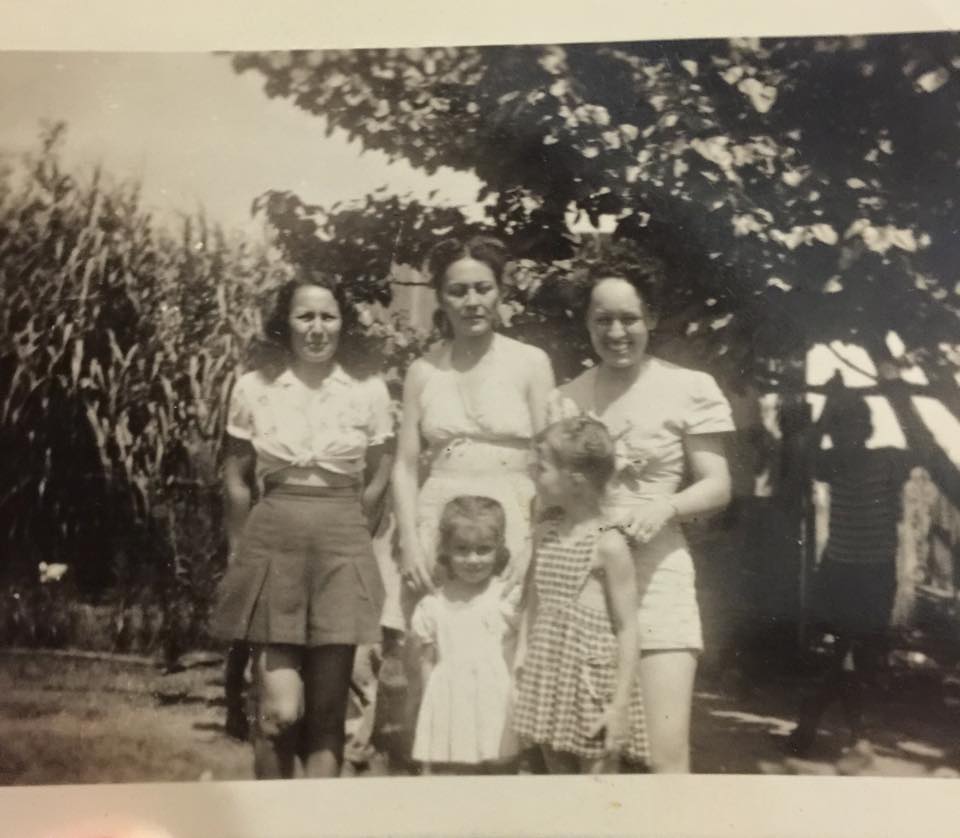
 CHIEF
CHIEF 
Very interesting project, Ms Louette. I am Dr. McGee’s friend “John” and she kindly provided me with a link to your work-in-progress. My Uncle Horace was one of Quanah’s great grandsons. Chief looks rather like my Uncle Horace when he was young.
I understand your passion with this work. And passion is a writer’s best friend. I do have an archive of circa 1900s real photos of small towns, counties, and the tribes of Oklahoma. I notice your interest in photography as well. Do you mind a inquiry as to which town or county was Chief’s home? Many of the counties were named after a dominant tribe, so Comanche County would be my first guest!
LikeLike
My grandparents originally lived in Anadarko, Caddo county, and then in Jefferson county. I read one of your books of photographs. It was very interesting.
LikeLike